Ultrafast Spectroscopy
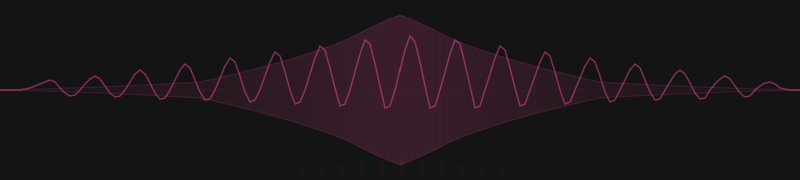
Femtosecond lasers for spectroscopy, quantum gates, and machine-learned pulse optimization
Context
Earlier work at the Indian Institute of Technology (IIT) Kanpur in the FemtoLab under Prof. Debabrata Goswami, spanning ultrafast laser spectroscopy and quantum computation. Less active today, but it set up the computational and spectroscopic habits that shape my later work.
Quantum computing with shaped pulses
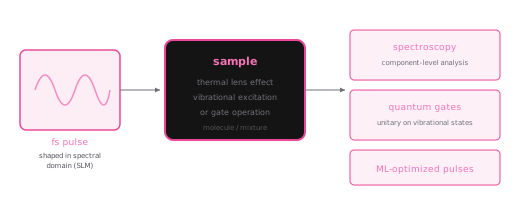
Femtosecond pulse shaping implements quantum gates on molecular qubits: the shaped pulse acts as a unitary operator on vibrational states, and the pulse shaper itself becomes the quantum circuit (Goswami and Goswami 2016). Follow-up work mapped where this approach breaks down as the qubit network grows beyond a few nodes (Goswami, Goswami, and Goswami 2019b).
Semi-classical computation and space-filling curves
Classical lasing simulations on large spatial grids are memory-bound. Structuring the grid traversal along a space-filling curve converts random memory access into sequential access (Goswami, Goswami, and Goswami 2019a). A semi-supervised extension added ML to the pulse-shape optimization loop (Goswami, Goswami, and Goswami 2021).
Fragrance spectroscopy
A recent collaboration took femtosecond thermal lens spectroscopy to fragrance mixtures (Goswami et al. 2025). Component-level signals survive the averaging that bulk spectroscopy washes out, so quality assessment of a blended perfume becomes non-destructive.
Open directions
- Revisiting pulse optimization with modern ML (deep reinforcement learning on pulse shaper parameters) now that compute is cheaper.
- Thermal lens spectroscopy as a rapid quality control tool for industrial fragrance production.