Ultrafast Spectroscopy
Femtosecond lasers for spectroscopy, quantum gates, and machine-learned pulse optimization
Background
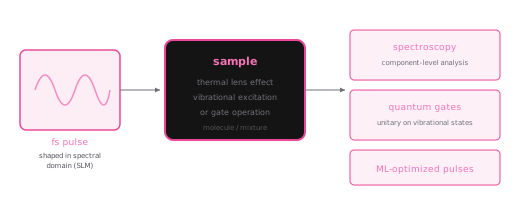
This thread covers work at IIT Kanpur in the FemtoLab under Prof. Debabrata Goswami, spanning ultrafast laser spectroscopy and quantum computation. While less active now, it established the computational and spectroscopic foundation for my later work.
Quantum computing with shaped pulses
Femtosecond pulse shaping can implement quantum gate operations on molecular qubits (Goswami and Goswami 2016). We explored how shaped laser pulses act as unitary operators on vibrational states, connecting experimental pulse shaping with quantum circuit design. Follow-up work examined the limits of this approach when qubit networks grow beyond a few nodes (Goswami, Goswami, and Goswami 2019b).
Semi-classical computation and space-filling curves
For classical lasing computations on large spatial grids, we used space-filling curves to structure the grid traversal (Goswami, Goswami, and Goswami 2019a), reducing memory access patterns from random to sequential. The semi-supervised extension applied machine learning to optimize pulse shapes for specific spectroscopic outcomes (Goswami, Goswami, and Goswami 2021).
Fragrance spectroscopy
A recent collaboration returned to thermal lens spectroscopy for analyzing fragrance mixtures (Goswami et al. 2025). Femtosecond thermal lensing provides component-level information that bulk spectroscopic methods miss, enabling non-destructive quality assessment of perfume blends.