Transition State Methods

Nudged elastic band (NEB), dimer methods, and tools for finding reaction pathways on potential energy surfaces
Context
Transition states set the rates of chemical reactions - catalysis, diffusion, phase transitions all hinge on them. Two method families dominate the calculation, and both show up across my work. Both turn out to be one algorithm under the hood - a single Bayesian optimization loop over a Gaussian-process surrogate, developed from first principles in a unified tutorial review (Goswami 2026a) (see the GP acceleration thread).
Double-ended: Nudged Elastic Band
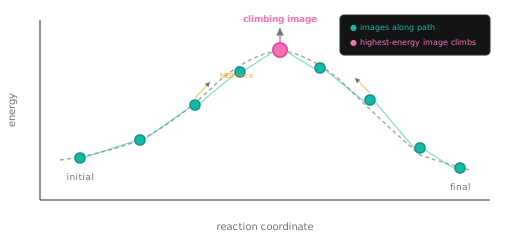
The nudged elastic band (NEB) connects a known reactant to a known product. Images are distributed along the path and linked by spring forces; the climbing-image variant pushes the highest-energy image uphill to land on the saddle.
Single-ended: Dimer Method
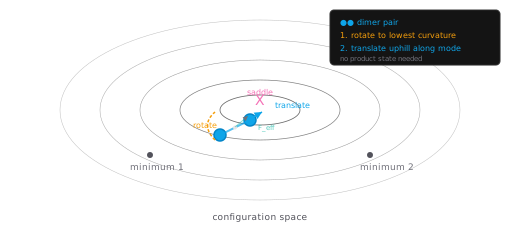
The dimer method needs only a starting geometry. A pair of configurations (the “dimer”) rotates to align with the softest Hessian eigenmode, then walks uphill along it. Two force evaluations per step, no product state required.
Adaptive CI-NEB and minimum mode following (MMF) hybrid
CI-NEB is reliable but spends most of its force evaluations on the final climb; minimum mode following (MMF) is cheap but can land on the wrong saddle if started too far from the transition basin. We combined them: run CI-NEB until the climbing image locks onto the right basin, then hand off to MMF to walk the rest of the way (Goswami, Gunde, and Jónsson 2026). A Bayesian regression on the Baker-Chan set with the PET-MAD machine-learned potential measures a median 57% reduction in energy and force evaluations (95% CrI: 50 to 64%) relative to standard CI-NEB, and 31% across 59 heptamer island transitions on Pt(111). A fixed force-cutoff switch at 0.5 eV/A costs 46% more force evaluations than the adaptive criterion - the switch point matters.
Reproducible NEB workflows
A full NEB run has four setup stages before the physics starts: endpoint minimization, structural alignment, path initialization, and band optimization. Most groups glue these together with one-off scripts that drift across projects and machines. We replaced the glue with a Snakemake workflow that couples PET-MAD to the eOn saddle search code and resolves every dependency from conda-forge (Goswami 2026b). The hydrogen cyanide (HCN) to hydrogen isocyanide (HNC) isomerization validates end-to-end with no manual intermediate steps.
Path visualization
A one-dimensional energy profile discards all geometric context. We project the path into two dimensions using the root-mean-square deviation (RMSD) to a reference, then overlay reliability contours from uncertainty estimates so the viewer can see both the energy barrier and the structural neighborhood it traverses (Goswami 2026c).
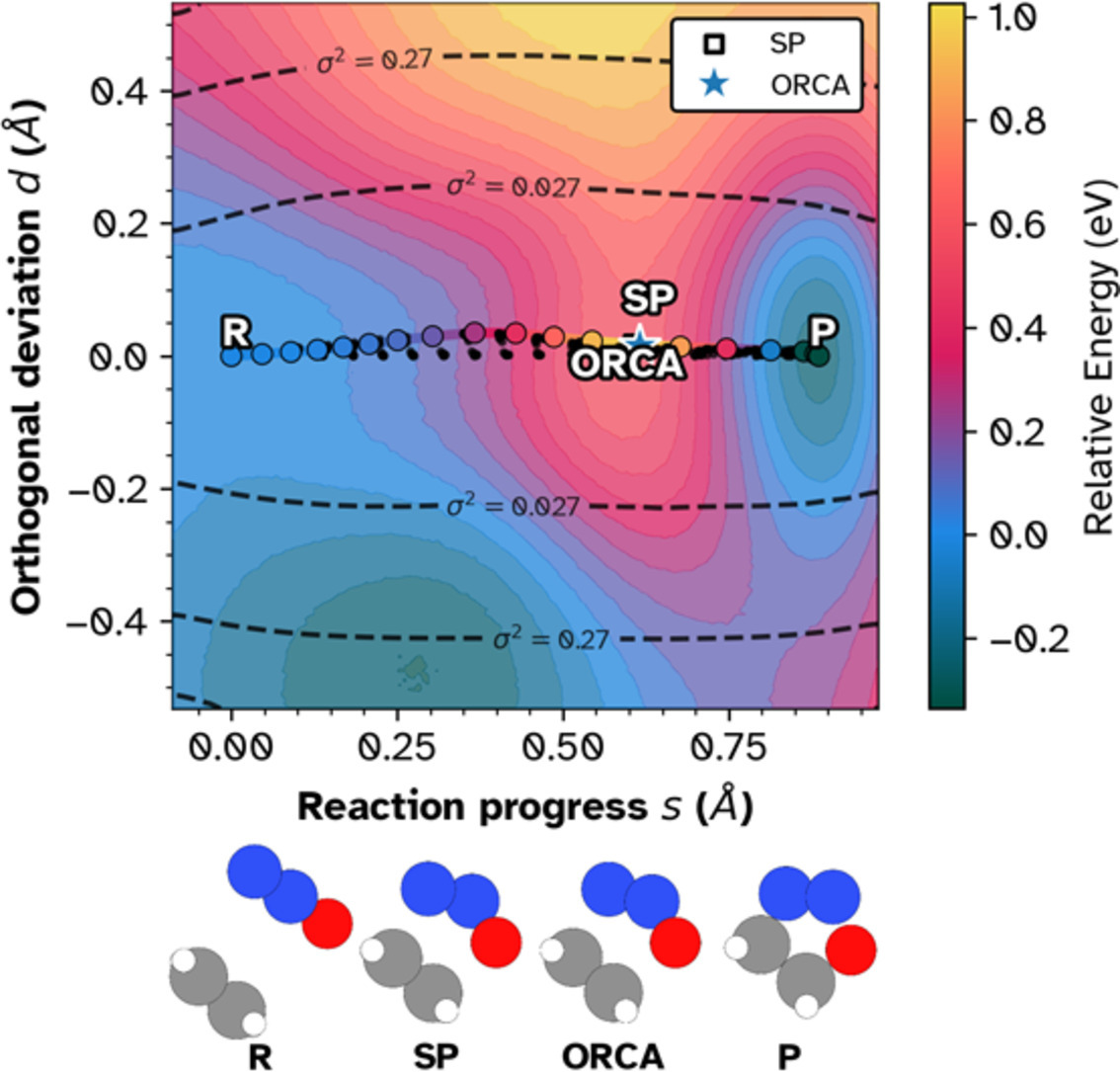
Figure 1: Graphical abstract from the MethodsX 2D RMSD visualization paper (Goswami 2026c).
Code
- eOn – Lead maintainer; NEB and dimer method implementations
- ASE – Contributor; eOn .con file I/O, NWChem writer, Protein Data Bank (PDB) handling
Tutorials
See also: engineering notes for the implementation under eOn in Software.
Open directions
- Extending the Hessian-enhanced CI-NEB to work with Smooth Overlap of Atomic Positions (SOAP) based ML potentials for automated discovery of reaction mechanisms in heterogeneous catalysis.
- Unified benchmarking framework for path-finding methods (the BENCH initiative at the Centre Europeen de Calcul Atomique et Moleculaire (CECAM)).
- Combining single-ended and double-ended methods adaptively based on landscape topology.