Molecular Sim

Ice nucleation, self-propelled particles, lava flows, and tools for trajectory analysis
d-SEAMS
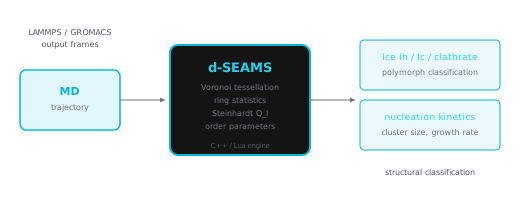
d-SEAMS (Deferred Structural Elucidation Analysis for Molecular Simulations) is a C++/Lua engine for ice and water structure analysis in MD trajectories (Goswami, Goswami, and Singh 2020). It classifies configurations using topological network criteria - Voronoi tessellation, ring statistics, Steinhardt order parameters - and distinguishes ice polymorphs (Ic, Ih, clathrate) from liquid water. Supported by a NumFOCUS Small Development Grant for documentation and training.
Ice nucleation on silver iodide
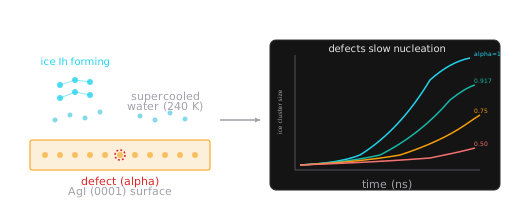
Silver iodide has seeded clouds for a century without a clear microscopic picture of how it templates ice. Classical MD on defective AgI surfaces shows that the lattice mismatch with ice Ih creates local strain, and whether that strain promotes or inhibits nucleation depends on the defect geometry (Prerna et al. 2019).
Self-propelled particles in crowded environments
Janus colloids self-propel via surface asymmetry. In semi-dilute polymer solutions their rotational diffusion is suppressed more strongly than their translational diffusion (Theeyancheri et al. 2020) - relevant to synthetic microswimmers moving through biological media, where the fluid is never ideal.
Lava emplacement prediction
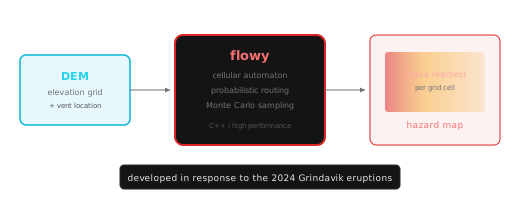
Flowy runs a cellular automaton on digital elevation models to produce probabilistic lava-flow maps (Sallermann et al. 2025). I contributed the numerical methods. The project began during the Grindavik eruption response.
Code
Open directions
- Applying d-SEAMS structural analysis to ML-generated trajectories where the potential energy surface is approximate.
- Probabilistic hazard mapping that couples lava emplacement with atmospheric dispersion models for volcanic ash.