Molecular Sim
Ice nucleation, self-propelled particles, and tools for analyzing molecular trajectories
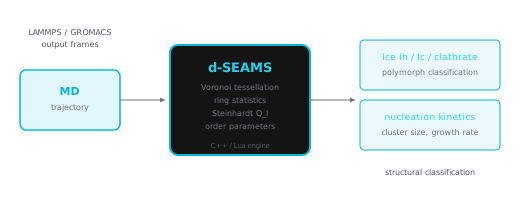
d-SEAMS
d-SEAMS (Deferred Structural Elucidation Analysis for Molecular Simulations) is a C++/Lua engine for analyzing ice and water structures in MD trajectories (Goswami, Goswami, and Singh 2020). It implements topological network criteria (Voronoi tessellation, ring statistics, Steinhardt order parameters) to distinguish between ice polymorphs (Ic, Ih, clathrate) and liquid water. NumFOCUS-funded for documentation and training materials.
Ice nucleation on silver iodide
Silver iodide has been used as a cloud seeding agent for decades, but the microscopic mechanism of ice nucleation on its surface was poorly understood. We studied how surface defects on AgI affect the nucleation process using classical molecular dynamics (Prerna et al. 2019). The lattice mismatch between the AgI surface and ice Ih creates strain that can either promote or inhibit nucleation depending on defect geometry.
Self-propelled particles in crowded environments
Janus particles (half-coated colloids that self-propel) behave differently in crowded polymer solutions than in pure solvent. We found that rotational diffusion is suppressed more strongly than translational diffusion in semi-dilute solutions (Theeyancheri et al. 2020), which affects how these particles navigate biological environments.
Lava emplacement prediction
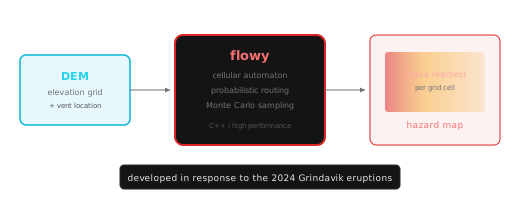
Flowy predicts probabilistic lava flow paths using a cellular automaton on digital elevation models (Sallermann et al. 2025). I contributed numerical methods. The code was developed in response to the Grindavik volcanic events.