ML Atomistic

Foundational libraries enabling ML models and simulation engines to communicate
Context
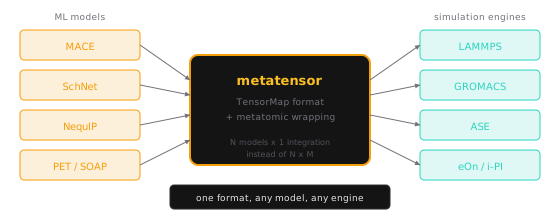
Atomistic ML lives in an O(M x E) world: M models (PyTorch, JAX, MACE, PET, …) times E simulation engines (LAMMPS, GROMACS, ASE, eOn). Every model-engine pair needs its own glue, and a model trained under one framework cannot be dropped into another without rewriting that glue.
The approach
Metatensor provides a shared data format (TensorMap) for atomistic ML tensors - descriptors, predictions, training labels - with metadata about which atoms and properties each block describes (Bigi et al. 2026). The format is framework-agnostic, sparse, and block-structured. Metatomic wraps trained models behind one interface that simulation engines call directly. Integration cost drops from O(M x E) to O(M + E).
My contributions
At the Ecole polytechnique federale de Lausanne (EPFL) labCOSMO I work on the systems-level pieces that make metatensor practical: DLPack support for zero-copy tensor interchange between PyTorch, NumPy, and the Rust core; device-aware execution that routes tensors to the right hardware; and performance tuning on the Rust side. On the simulation side, I maintain the integration with eOn for saddle point searches and work on the GROMACS integration, including embedding machine-learned interatomic potentials (MLIPs) inside molecular mechanics (MM) so an MLIP can drive a reactive subsystem inside a classical force field.
Code
- metatensor – Contributor (DLPack, device management, Rust core)
- metatomic – Contributor
- metatrain – Contributor (training infrastructure)
- metatensor-gromacs – GROMACS integration (MLIP-in-MM embedding, domain-decomposition scalability, device-aware threading)
- vesin – Neighbor list library
- rgpot – RPC-based potential interface (GitHub)
- ChemGP – Chemically motivated Gaussian processes
- Atomistic Cookbook – Tutorial recipes for the ecosystem
Open directions
- Embedding machine-learned interatomic potentials (MLIPs) in molecular mechanics (MM) in GROMACS through metatomic: an ONIOM-style subtractive scheme (E = E_MM(full) + E_MLIP(region) - E_MM(region)) that runs an MLIP on the reactive subsystem while the surrounding classical force field handles the bulk. The open problems are energy conservation across the MLIP/MM boundary (the Torch thread count has to match the MD engine to keep the drift small) and correct bonded-term bookkeeping, where only interactions with every atom in the MLIP region are removed and boundary bonds, angles, and dihedrals stay with the force field. This is the route to MLIP-accuracy reaction modelling in explicit solvent at molecular-mechanics cost.
- Hardware-aware execution paths in metatomic: automatically selecting GPU vs CPU kernels based on system size and available devices.