Leidarljos
Persistent memory, provenance, and coordination for AI tools
Context
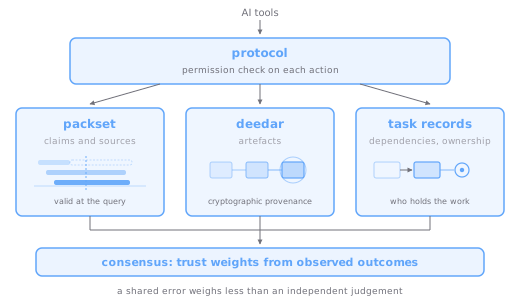
Leidarljos is open-source software for persistent memory and coordinated work across AI tools. Memory, recorded artefacts, task dependencies, and work ownership have separate responsibilities. A common protocol connects them, and permission checks govern tool actions. The implementation and a public reproducibility package are available. A memory manuscript is in draft. This page describes the system and the questions under study.
Memory with explicit validity
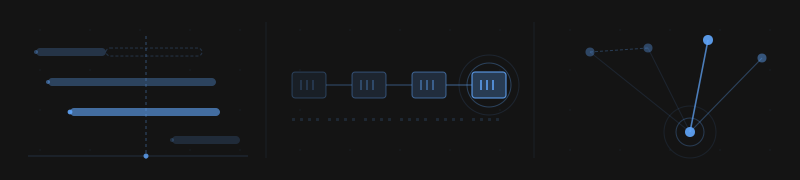
The packset store records claims written on purpose, together with their sources and the periods for which they apply. Superseded claims stay available, so a query can ask what was known on an earlier date. Retrieval combines lexical and semantic search. A build instruction can go stale. A numerical result can be replaced by a corrected calculation. The research question is how retrieval should account for validity, conflicting evidence, and review history, and how a reader reconstructs the earlier state.
Provenance and recovery
The deedar component stores artefacts with cryptographic provenance. Task and ownership records name dependencies and the worker responsible for each piece of work. The questions are when a result can be accepted, reused, or handed to another worker, and what recovery costs after an interrupted calculation, a changed dependency, a duplicate worker, or a corrupted transfer.
Coordination
Consensus methods combine judgements using trust weights and update those weights from observed outcomes. The statistical questions are calibration, correlated errors, and specialisation. Agreement among workers who share an error is weak evidence. Comparisons use independent judgements and majority voting under a matched budget, and they record decision quality, communication, and recovery when a worker fails.
Where it meets the other work
f2py interface changes, eOn calculations, rsx analysis workflows, and deployment on HPC systems are the applications. Checks combine regression tests, reference implementations, and mathematical or physical invariants, with their assumptions and tolerances stated.
Code
- Leidarljos – documentation
- leidarljos/bench – public reproducibility package