GP Acceleration

Surrogate energy surfaces via Gaussian process regression for 10x fewer force evaluations
Context
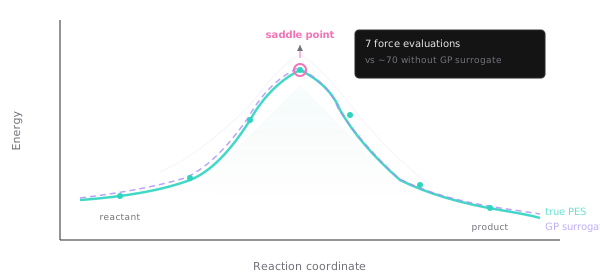
A Gaussian process (GP) regression builds a surrogate energy surface on the fly from the force evaluations it has already computed. The GP predicts energies and forces at unseen configurations and flags where its own uncertainty is highest, so the saddle search spends its next electronic structure calculation where it matters most. Force evaluation counts drop by roughly an order of magnitude relative to the standard dimer method (Goswami et al. 2025).
The implementation lives in the eOn saddle point search code, runs in plain Cartesian coordinates, and drops into any electronic structure code via eOn’s remote procedure call (RPC) potential interface.
Adaptive pruning
A GP’s cost to update grows cubically with the dataset size. On long runs the surrogate becomes the bottleneck before the density functional theory (DFT) calculation does. We prune the training set using farthest-point sampling guided by the Earth Mover’s Distance - a permutation-invariant metric for structural similarity - and halve wall time with no loss of accuracy (Goswami and Jónsson 2025). The work ran as the cover feature in ChemPhysChem 1.

Optimal Transport representation
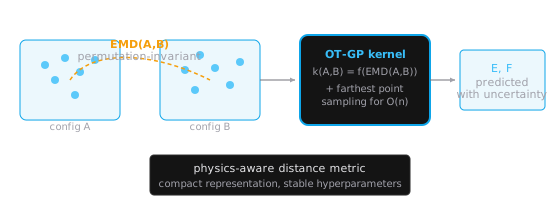
Chapter 8 of the thesis replaces Cartesian coordinates with the Earth Mover’s Distance (EMD) as the GP’s similarity metric. EMD is permutation-invariant and captures chemically meaningful distances between molecular configurations. Combined with farthest-point sampling for data selection and adaptive trust radii for hyperparameter stability, this yields the Optimal Transport Gaussian Process (OT-GP) framework.
A unified Bayesian optimization view
The dimer, the nudged elastic band, and plain minimization are not three methods but one: a single six-step surrogate loop that differs only in the inner optimization target and the acquisition criterion. An invited tutorial review develops this unification from first principles, with derivative observations, inverse-distance kernels, active learning, and the production extensions - farthest-point sampling with the Earth Mover’s Distance, maximum a posteriori (MAP) regularization, an adaptive trust radius, and random Fourier features - that carry the methods into high-throughput use (Goswami 2026). The accompanying pedagogical Rust code, ChemGP, runs all three searches from the same loop, so every equation maps to a line of code.
Code
- eOn – Lead maintainer; GP saddle search integration
- ChemGP – Author; pedagogical Rust reference unifying the GP search loop
See also: engineering notes for eOn under eOn in Software.
Open directions
- Scaling the OT-GP framework to adaptive kinetic Monte Carlo for long-timescale simulations: millions of atoms, thousands of kinetic Monte Carlo (KMC) steps per day.
- Extending the GP-accelerated saddle machinery to excited-state surfaces and photocatalytic reactions, where each electronic-structure call is even costlier.
- Combining GP surrogates with ML potentials (the GP predicts corrections to the ML potential, not the full DFT surface).
- Automatic hyperparameter selection using the EMD landscape structure.
References
Cover design by Ruhila Goswami. ↩︎