GP Acceleration
Surrogate energy surfaces via Gaussian process regression for 10x fewer force evaluations
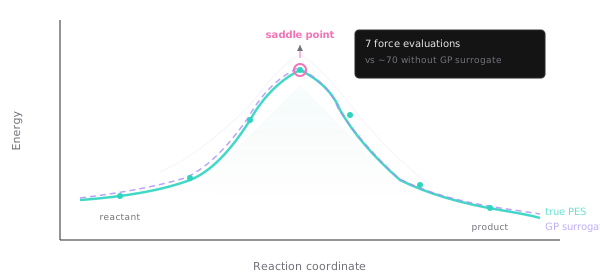
The approach
Gaussian process (GP) regression builds a surrogate energy surface on the fly, interpolating between the few force evaluations already computed. The GP predicts energies and forces at new configurations, and its uncertainty estimates indicate where to sample next. This reduces force evaluation counts by roughly 10x compared to the standard dimer method (Goswami et al. 2025).
The implementation lives in the eOn saddle point search code. It works in simple Cartesian coordinates rather than requiring specialized internal coordinates, and interoperates with standard electronic structure codes.
Adaptive pruning
As the GP collects data during a search, the cost of updating the model grows cubically with dataset size. On large problems, the surrogate itself becomes the bottleneck. We solve this with farthest-point sampling guided by the Earth Mover’s Distance, a metric that measures structural similarity between molecular configurations in a permutation-invariant way. This adaptive pruning halves wall time while preserving accuracy (Goswami and Jónsson 2025). The work earned a cover feature in ChemPhysChem.

Code
- eOn – Co-maintainer; GP saddle search integration
Related writing
- Handling legacy Fortran code on rgoswami.me